Lower Elementary Program

Grades 1 - 3

Awakening Their Inner Strengths

Connecting Ideas. Inspiring Understanding.

  • For families who have watched their children grow in confidence, independence, and curiosity throughout PreK–K, Lower Elementary is a natural next step; a seamless and enriching continuation of the Montessori journey.
  • In Grades 1–3, Elementary students enter an exciting new stage of development. Their curiosity expands, their questions become more complex, and they are ready to explore ideas in greater depth. Our Montessori Lower Elementary classrooms provide the freedom, and structure children need to investigate, ask thoughtful questions, make meaningful connections, and take increasing ownership of their learning.
  • Through engaging lessons and hands-on experiences, students build upon the strong academic foundations developed in PreK–K while developing greater focus, critical thinking, problem-solving, and independence. Lessons in Grace and Courtesy, along with Montessori Peace Education principles, support children as they develop self-esteem, responsibility, self-discipline, respect, empathy, and appreciation for their role within the community.
  • This balanced approach recognizes that academic growth and personal growth go hand in hand. Children are encouraged to become active participants in their education, developing not only the knowledge and skills needed for academic success, but also the confidence, independence, and sense of responsibility to navigate the world around them.
  • The result is a vibrant and purposeful learning environment where children are challenged to think deeply, encouraged to follow their curiosity, and supported as they grow into confident, capable, and compassionate learners.

Interconnected Academic Experience

In Montessori, subjects do not exist in isolation. Our curriculum intentionally connects Mathematics, Science, Zoology, Botany, History, Geography, and Language Arts, allowing children to develop conceptual clarity while making meaningful connections across subject areas.

  • Our Lower Elementary curriculum is designed as a cohesive and interconnected learning experience. Through timelines, concrete materials, hands-on experiments, stories, research, and compelling visual resources, students explore concepts from multiple perspectives and develop a deeper understanding of how ideas connect.
  • Learning extends beyond the classroom through education at Montessori Acres Farm. Farm experiences give students the opportunity to apply classroom learning to the living world around them. They may observe plant and animal life, explore ecosystems and life cycles, investigate weather and seasonal changes, and connect concepts from Science, Geography, Mathematics, and practical life to real-world experiences. These firsthand observations transform abstract ideas into meaningful, memorable learning.
  • Rather than simply memorizing facts, students are encouraged to ask questions, investigate ideas, seek answers, and make discoveries of their own. They learn to recognize patterns, think critically, and understand how individual pieces of knowledge fit together to form a larger picture.
  • This approach transforms learning from the simple acquisition of information into an engaging process of discovery. It nurtures curiosity, strengthens critical-thinking skills, and inspires children to become enthusiastic, independent learners.

At MAV, learning is not confined to a subject, a lesson, or even a classroom. It is a connected journey of discovery.

Skills for Life. Confidence for Tomorrow.

Academic excellence is thoughtfully balanced with the development of essential life skills, empowering children to become confident, capable, and responsible learners. In Lower Elementary, children are increasingly encouraged to take responsibility for their choices, their work, and their role within the classroom community. Through this balance of academic learning and personal development, students strengthen the skills they will carry with them far beyond the classroom.

This core area of the Montessori experience nurtures the development of:

  • Logical Reasoning and Critical Thinking:Ask relevant questions, evaluate ideas, and solve problems thoughtfully.
  • Collaboration and Conflict Resolution:Communicate respectfully, work with others, and navigate differences constructively.
  • Time Management and Personal Responsibility:The ability to organize work, manage time, follow through on commitments, and be accountable.
  • Confidence in Self-Directed Learning:Initiative, independence, focus, and confidence in ownership of their learning.
  • Language Arts:Communication, reading, writing, vocabulary, and comprehension.
  • Mathematics:Calculating, reasoning, problem-solving, and a deeper understanding of numerical concepts.
  • Cultural Studies:Science, History, and Geography and discovering the connections between people, places, and cultural awareness around the world.
  • Sensorial Exploration:Refining observation, classification, recognizing sequence, patterns, farm adventures and its connections.
  • Art & Music:Creativity, self-expression and appreciation
  • Social Interaction and Community:Empathy, respect, cooperation, leadership.

Our goal is not simply to prepare students for the next grade. It is to help them become thoughtful, capable young people who know how to study, work with others, and take responsibility for themselves and their surroundings.

A Glimpse into the Rich Curriculum for 1st-3rd Graders

Mathematics

  • Arithmetic Computation
  • In Depth study of Addition, Subtraction, Multiplication and Division
  • Geometry
  • Algebra
  • Decimals
  • Comprehensive study of Problem Solving in Addition, Subtraction, Multiplication and Division

Language

  • Sentence Structure
  • Grammar/ Parts of Speech
  • Phonograms
  • Blends
  • Spelling
  • Reading Comprehension

History

  • Timelines
  • Origins of Life (Plants, Animals, People)
  • Human Communities Cultures
  • World History
  • Modern History
  • Famous People/Places
  • Open-ended Research

Geography

  • The Universe, Solar System and Earth
  • Origins of Earth, Solar Energy, Atmosphere
  • Map Reading/ Globe
  • Cultures in Relation to Geographic Locations
  • Global Education
  • Countries within Continents, Capitals and Flags
  • Open-ended Research

Sciences

  • Study of Plants
  • Study of Animals
  • Physical Science
  • Basic Chemistry
  • Science Experiments
  • Health and Nutrition
  • Open-ended Research

The Fine Arts

  • Music Appreciation
  • Singing and Rhythm
  • Study of Composers
  • Poetry Appreciation
  • Arts and Crafts
  • Study of Artists and Art Mediums
  • Open-ended Research

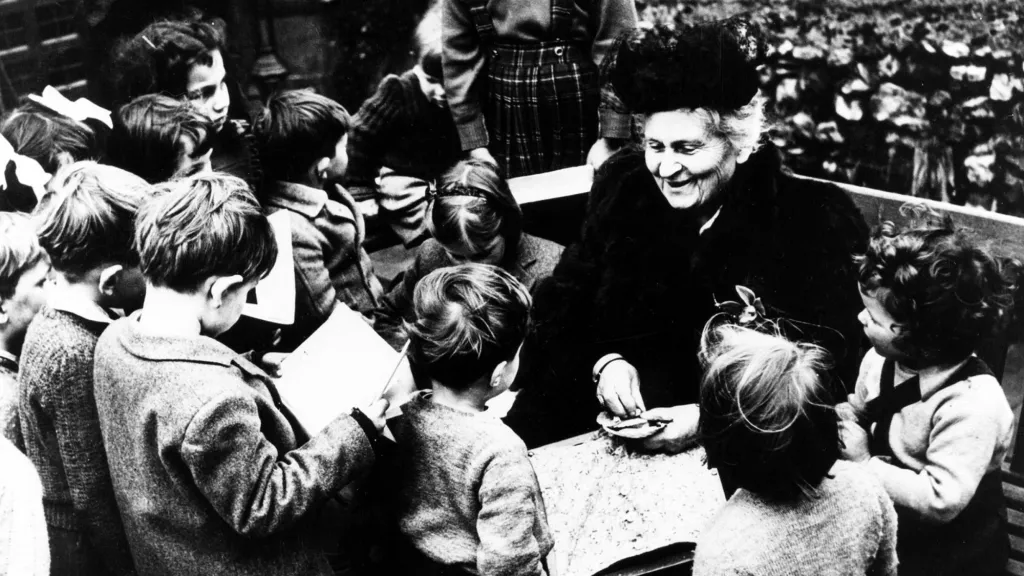
Knowledge is best given where there is eagerness to learn, so this is the period when the seed of all things can be sown, the child’s mind being like a fertile field, ready to receive what will germinate into a culture.
Dr. Maria Montessori