Pre-K & Kindergarten Program (Children's House)

3+ to 6 years old

A place where learning is hands-on, purposeful, and joyful

Our PreK–K Children’s House program provides a rich and engaging learning environment where children have the time, space, and guidance they need to become confident, capable, and independent learners. Within calm, thoughtfully prepared, multi-aged classrooms, children ages 3 to 6 learn through meaningful choices, hands-on experiences, purposeful practice, problem-solving, and the deep satisfaction that comes from accomplishing tasks independently.

The multi-age classroom is a defining part of the Montessori experience. Younger children have the opportunity to observe, learn from, and be inspired by older classmates. Older children naturally develop leadership, patience, empathy, and compassion as they support and encourage their younger peers. Each PreK-K child is given the freedom to grow at their own pace while developing a strong sense of belonging, responsibility, and connection within the classroom community.

This balanced approach to early education builds strong academic foundations while nurturing curiosity, independence and self-motivation.

Throughout their three-year PreK–K experience, children explore five interconnected areas of learning:

  • Practical Life - Growing Independence
  • Nurturing Curiosity, Inspiring Discovery
  • Language Arts
  • Math and Geometry
  • Exploring Our World
  • Farm Life

Personalized Learning. Every Stage. Every Learner.

Helping Kindergarteners to build meaningful connections to their learning.
Practical Life Skills - Growing Independence

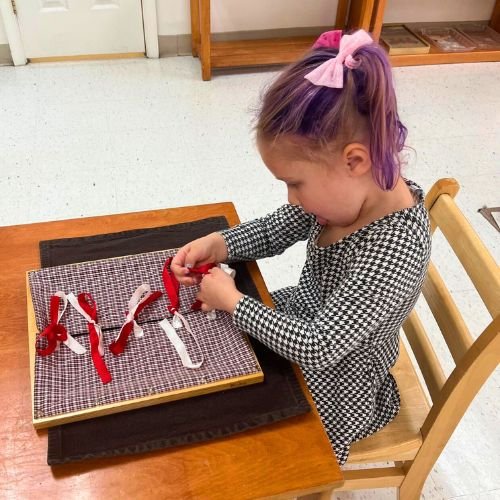
  • In our Montessori classrooms, even the simplest activities have a meaningful purpose. Through hands-on experiences, children learn to care for themselves, their environment, and the community around them. They may pour, scoop, button, organize their workspace, care for a plant, or return materials to their proper place; each activity helps children develop logical and sequential thinking that extends far beyond the task itself.
  • As children practice these everyday skills, they develop concentration, coordination, sequencing, problem-solving, and a growing sense of responsibility. They learn to slow down, pay attention, complete a task, and attempt again when something feels challenging. Most importantly, they begin to discover the empowering thought: “I can do it myself.”
  • This growing independence builds confidence, self-discipline, and the ability to make thoughtful choices. These are the foundations for becoming not only a capable student, but also a confident, responsible, and caring member of a community.

Nurturing Curiosity, Inspiring Discovery

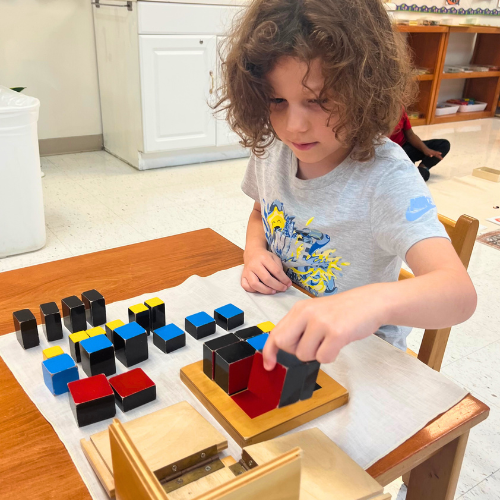
  • Young children are naturally curious. They want to touch, observe, listen, compare, sort, and discover how things are alike and different. The Montessori approach honors this natural curiosity by providing purposeful, hands-on opportunities that allow children to explore and understand their environment through their senses.
  • Through carefully designed Montessori materials, children learn to observe details and make increasingly precise distinctions. They may explore differences in height, length, thickness, weight, color, texture, sound, and other components. These experiences encourage children to slow down, pay attention, and develop a deeper appreciation for the details in the world around them.
  • As children work with these materials, they begin to recognize patterns, sequences, sizes, shapes, and relationships. Activities such as sorting, matching, grading, and classifying may appear simple, but they are intentionally designed to strengthen visual and auditory discrimination, concentration, problem-solving, and the ability to organize and process information.
  • Sensory materials also provide a concrete foundation for early mathematical and geometric concepts. Children first see, touch, compare, and explore ideas with their hands and senses. Over time, they connect these experiences to vocabulary, measurement, shapes, quantities, and mathematical relationships.
  • Rather than simply memorizing concepts, children build meaningful understanding through exploration, discovery, and hands-on experiences. Curiosity becomes the starting point, discovery becomes the process, and understanding grows naturally from the experiences.

Language Arts - Growing a Love of Language

  • Children are naturally drawn to language. Through conversations, stories, songs, rhymes, books, and opportunities to share their own ideas, they develop vocabulary, listening skills, self-expression, and confidence. These early experiences create a strong foundation for reading, writing, and meaningful communication.
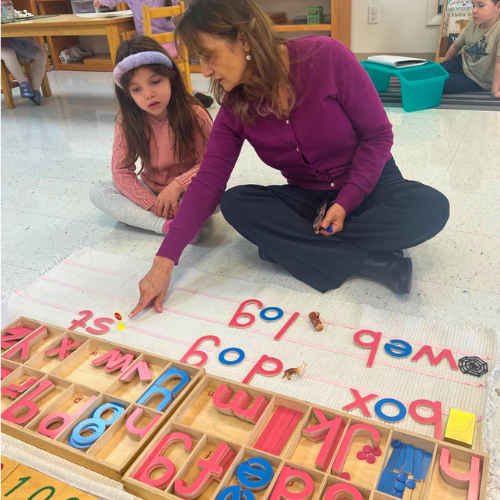
  • Montessori introduces children to letters and their sounds through engaging, tactile experiences. With materials such as Sandpaper Letters, children see the shape of a letter, hear its corresponding sound, and trace its form with their fingers. This multisensory approach creates a strong connection between sound and symbol while strengthening the fine-motor skills needed for writing.
  • As children become familiar with letter sounds, they begin blending sounds to create words of their own. Using the Movable Alphabet, children express their ideas in written form even before they are ready to write with a pencil. This is a wonderful moment of discovery: children realize that their thoughts can be transformed into words, messages, stories, and meaningful expressions.
  • Throughout this process, children strengthen phonemic awareness, expand their vocabulary, develop listening and speaking skills, and build the essential foundations for successful reading and writing.
  • Our goal is not simply to teach children how to read. It is to nurture a genuine love of language and help each child experience the joy, excitement, and confidence that comes with becoming a reader.

Math and Geometry - Building Confident Mathematical Thinkers

  • Young children are natural mathematicians. They count, sort, compare, and recognize patterns as they explore the world around them. Our Montessori Math Curriculum builds on this natural curiosity through a clear, logically sequenced approach that allows children to experience and understand mathematical concepts before moving toward abstract thinking.
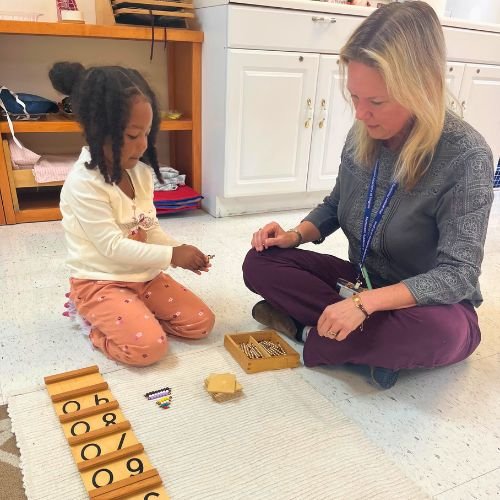
  • Children begin with concrete materials that make numbers and quantities visible and tangible. Through hands-on experiences, they learn to recognize numerals, count accurately, understand number sequences, compare quantities, and discover relationships between numbers.
  • As their understanding develops, children work with increasingly larger numbers and quantities and are introduced to the four basic operations—addition, subtraction, multiplication, and division. The Montessori approach allows children to physically experience these operations rather than simply memorize procedures. Early concepts of fractions are also introduced in ways that make mathematical relationships concrete, accessible, and engaging.
  • This hands-on progression strengthens number sense, logical reasoning, problem-solving skills, and confidence. Over time, children move naturally from concrete materials toward increasingly abstract mathematical concepts, building understanding at each step.
  • Most importantly, children discover that mathematics is something they can understand, explore, and enjoy—not simply memorize.
  • Our goal is to nurture confident mathematical thinkers who are curious about numbers, comfortable solving problems, and excited to discover what comes next.

Exploring Our World

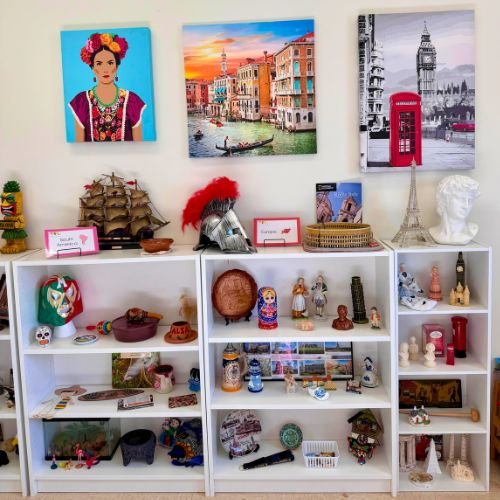
  • Children are naturally fascinated by the world we live in. They wonder: Where are we on a map? What was life like long ago? Where do other children live, and what are their lives like? Our Geography and History curriculum provides meaningful opportunities for children to explore these questions and discover the answers for themselves.
  • From an early age through hands-on experiences, children gradually develop an understanding of the world around them. They explore maps and globes, learn the names and locations of continents and landforms, and discover the diverse environments found across our planet. They investigate weather, seasons, life cycles, and the natural world while building vocabulary and strengthening observation, classification, and critical-thinking skills along the way.
  • These experiences help children develop a growing sense of place and an appreciation for the diversity, beauty, and interconnectedness of our global community.
  • History is introduced in ways that are meaningful and accessible to young children. Through family trees, timelines, stories, and the study of notable historical figures, children begin to understand the passage of time and discover how people and events have shaped the world we live in today.
  • Our goal is to help children see themselves as part of a larger world—one filled with fascinating places, diverse people, rich cultures, and stories waiting to be discovered.

A Classroom without Walls

Montessori Acres
  • At MAV, learning extends beyond the classroom. Our Zoology and Botany studies introduce children to the living world through concrete, hands-on materials that help them develop an understanding of plants, animals, and nature. Children are introduced to age-appropriate concepts and vocabulary that encourage them to observe, classify, compare, and develop a deeper appreciation for the natural world.
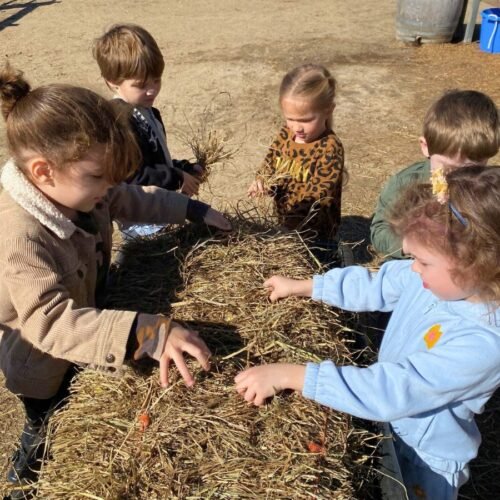
  • These classroom lessons come to life through hands-on learning at Montessori Acres Farm. During rotating visits to the farm, children have opportunities to observe plants and animals in their natural environments and experience concepts firsthand. They explore plant life, life cycles, changing seasons, weather patterns, and the processes involved in growing and caring for plants and animals.
  • Through these experiences, children strengthen their observation skills, expand their vocabulary, and begin to understand the interconnectedness of living things and their environment. Caring for plants and animals also nurtures responsibility, patience, and respect for life.
  • Most importantly, children develop a meaningful connection with nature—not simply by learning about it, but by seeing it, touching it, caring for it, and experiencing it firsthand.
  • At Montessori Acres, the natural world becomes their classroom.

Knowledge is best given where there is eagerness to learn, so this is the period when the seed of all things can be sown, the child’s mind being like a fertile field, ready to receive what will germinate into a culture.
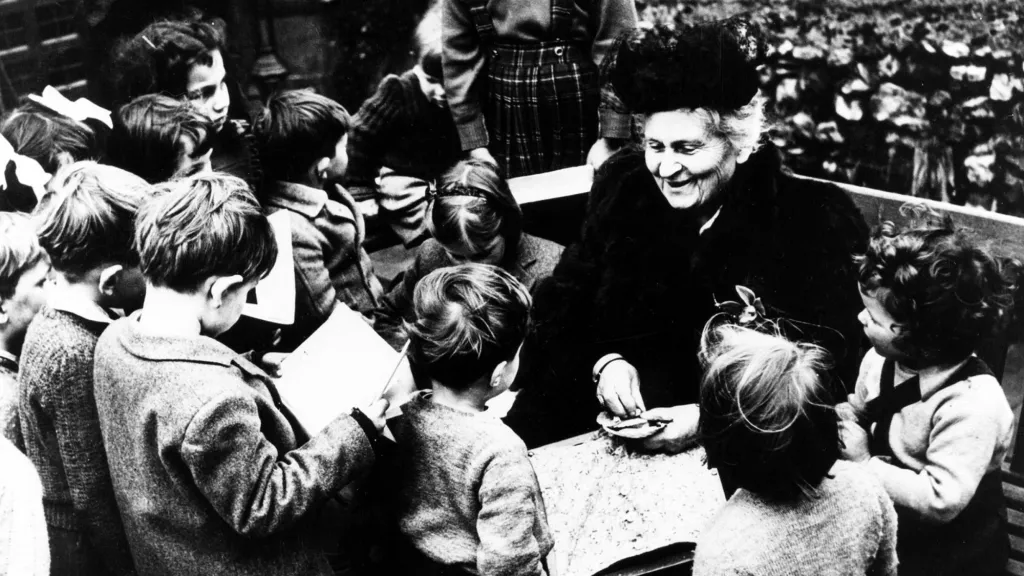
Dr. Maria Montessori