contact@montessoriva.com

Pre-K & Kindergarten Program (Children's House)

3+ to 6 years old

A Foundation for Academic and Personal Growth

Our PreK–K (Children’s House) program offers a rich, dynamic learning experience thoughtfully designed to cultivate independence, curiosity, and a lifelong love of learning. Within a calm, structured, multi-aged classroom, children develop mutual respect, personal responsibility, and confidence through meaningful opportunities for peer mentorship and collaboration.

This beautifully balanced introduction to education supports the development of strong academic foundations alongside independence and self-motivation. Through purposeful, hands-on exploration in language, mathematics, culture, and practical life, children ages 3 + to 5+ grow into capable, curious, and joyful learners—well prepared for the next stage of their educational journey.

The PreK–K curriculum integrates intellectual, practical, and creative learning across five core areas:

  • Life Skills (Practical Life)
  • Sensorial Exploration
  • Language Arts
  • Mathematics
  • Cultural Studies (Social Studies, History, and Science)

By the completion of the three-year PreK–K cycle, students have developed not only strong academic readiness but also essential life skills—focus, independence, compassion, and curiosity that prepare them to thrive in the Elementary years and beyond.

Tailored Learning for Every Stage of Growth

At MAV, we believe in fostering independence, confidence, and a lifelong love for learning from the very beginning. Our carefully designed programs cater to each stage of your child’s development, building essential skills and a deep connection to their world.
Self-Independent Activities (Practical Life)

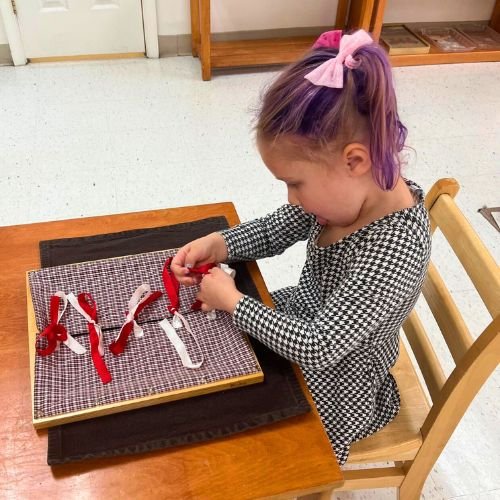
  • Although seemingly unsophisticated and simple, these activities play a crucial role in helping students develop logical and sequential thinking. Through guided practice, children gain an understanding of foundational mathematical concepts while simultaneously fostering independence, self-discipline, focus, and responsibility.
  • These lessons also nurture positive learning habits, building self-confidence, and encouraging personal accountability; essential life skills that support both academic growth and solid citizenship.

Discovery Activities

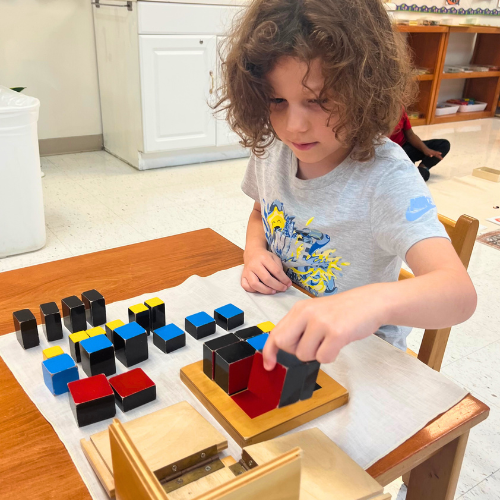
  • Children explore and interact with their physical world through their senses. The Sensory/Discovery Curriculum is designed to help children develop focused attention and careful observation of their surroundings.
  • Students begin with simple exercises, such as sorting a prepared series of objects that differ by only one attribute—height, length, or width. As they progress, they challenge themselves by exploring additional properties, including weight, color, sound, and temperature.
  • Through these activities, children gain an understanding that Sensory materials are systematically graded. This structured approach lays a solid foundation for future Mathematics and Geometry learning, linking hands-on discovery directly to abstract concepts.

Language Activities

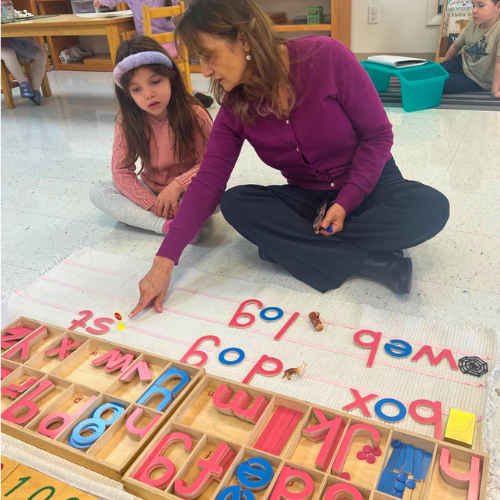
  • In Montessori Education, foundational language skills are taught phonetically, focusing on letter sounds rather than letter names. Using hands-on materials of Sandpaper Letters, children develop a tactile muscular memory of each letter’s shape through tracing, which supports correct handwriting and prepares them for future writing success.
  • Once letter sounds are mastered, students begin composing their own words and sentences using the Movable Alphabet, fostering creativity and independence in written expression. In parallel, children engage in a variety of pre-reading exercises, including sound discrimination, phonemic awareness activities, and vocabulary enrichment.
  • Language learning is further enhanced through immersive experiences such as songs, rhymes, meaningful conversations, and daily read-aloud sessions, helping children connect words to their environment while building confidence and a love for reading.

Mathematics and Geometry

  • The mathematics curriculum provides a clear and logical framework designed to help children build a strong foundation across all domains of mathematics.
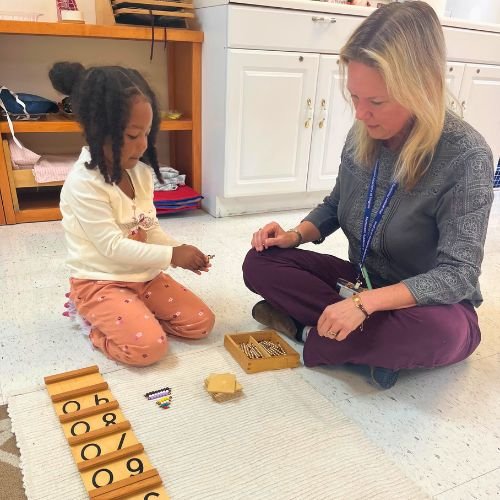
  • At this stage, learning is hands-on and concrete. Core materials allow children to explore numerals, quantities, sequences, and basic computations, gradually expanding to include larger numbers up to the thousands.
  • Manipulatives offer a tangible understanding of mathematical operations—including addition, subtraction, multiplication, and division—while also introducing early concepts of simple fractions. Through these carefully designed experiences, children develop both conceptual comprehension and practical problem-solving skills, fostering confidence and a lasting engagement with mathematics.

Global Cultures, Botany, History, and Sciences

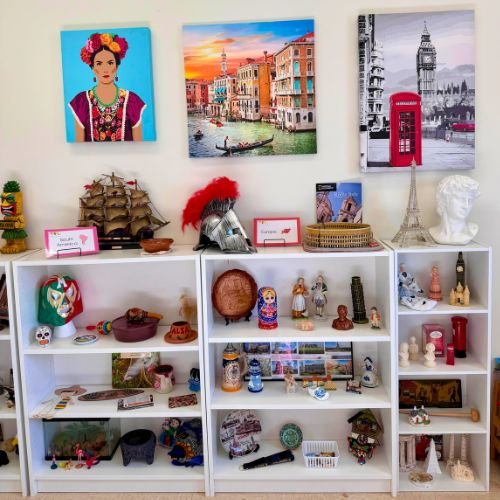
  • Global studies encourage students to observe, analyze, predict, and explore the world around them. From an early age, students engage with maps, learn the names of continents, study various land formations, and explore the natural sciences, including plants, animal anatomy, life cycles, and weather patterns. This strong foundational knowledge equips every student to investigate their surroundings with curiosity and confidence.
  • Zoology and Botany are initially introduced in the classroom, providing students with concrete concepts and vocabulary. These subjects are further enriched through hands-on experiences at Montessori Acres. During rotating visits to the farm, students observe natural environments, understand growing seasons, and interact with animal life, reinforcing their connection to the natural world.
  • History is gradually introduced through family trees, notable historical figures, and timelines, helping students develop a clear understanding of past events and human stories.

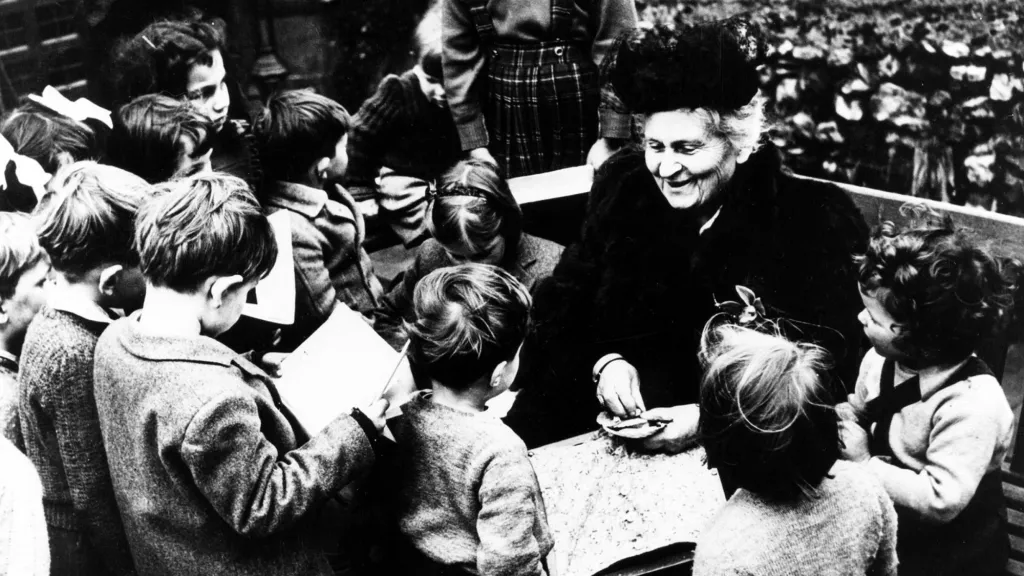
Knowledge is best given where there is eagerness to learn, so this is the period when the seed of all things can be sown, the child’s mind being like a fertile field, ready to receive what will germinate into a culture.
Dr. Maria Montessori